Every label is a prediction: a leadership lesson about people
Gifted, high potential, not leadership material. Every label is a guess about the future. Here is how leaders keep labels as doors, not walls.
Read the essay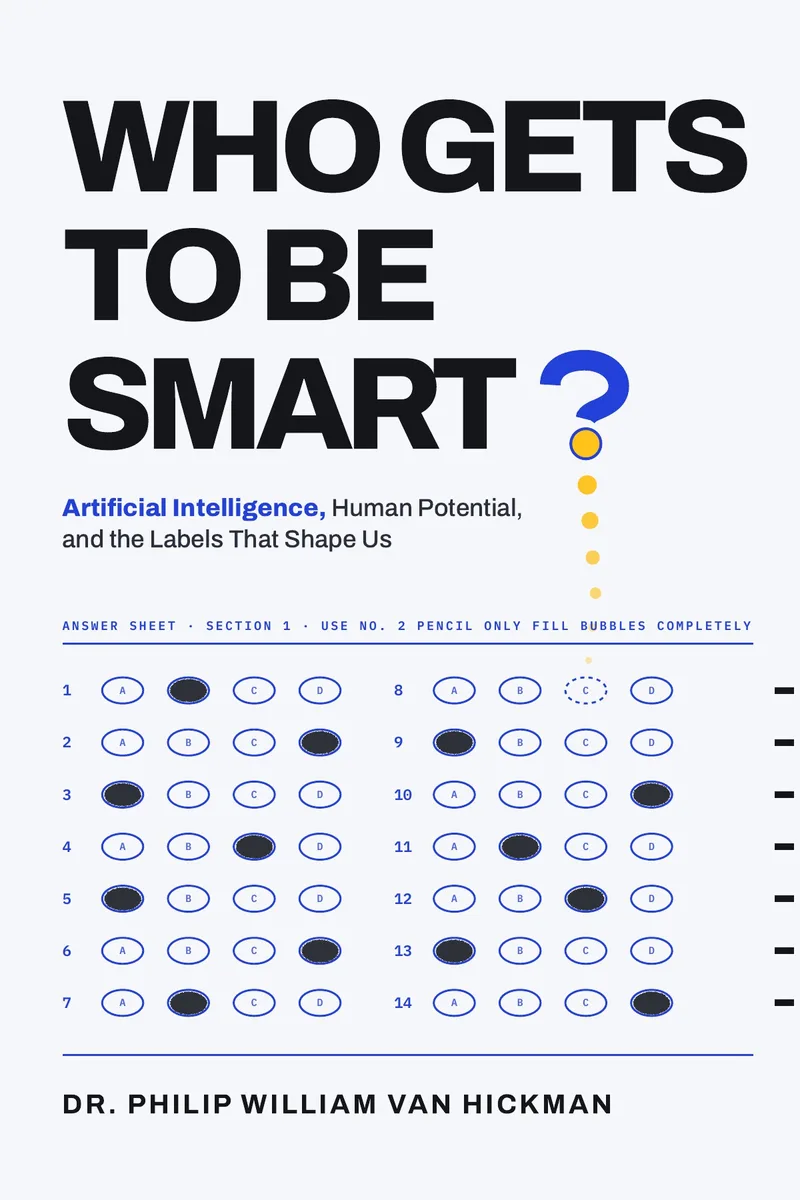
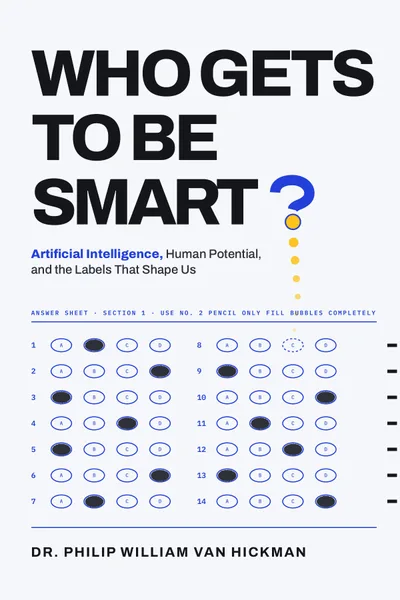
Artificial Intelligence, Human Potential, and the Labels That Shape Us
By Dr. Philip William Van Hickman · Ember House Press · 178 pages
Every label is a prediction about a person, and as tests and AI do more of the labeling, this book gives you four questions to keep each label a door, not a wall.
Every label is a prediction about a person. Drawing on years of evaluating students, Dr. Van Hickman shows what tests and AI see, and miss, in students and employees. The DOOR Test helps parents, educators, and CEOs keep labels as doors, not walls.
Most of us assume intelligence is a fixed thing inside a person and a good test simply measures it. The history says otherwise: specific people, at specific moments, chose what would count as smart for specific purposes. Every label is a prediction wearing the costume of a fact.
I give these tests for a living, and I believe in them, used well. A test shows you very clearly exactly what it is pointed at, and everything else stays in shadow. A score is a sentence, not a story, and the skill is knowing which sentence you are holding.
A label does not only describe a person. It instructs teachers what to teach, managers what to assign, and the person inside the label what to expect of themselves. I call this the expectation echo, and over time it produces the very evidence that seems to prove the label right.
A machine label can look more objective than a person's, but somebody chose the data, the cutoff, and the name of the label. Data is a rearview mirror: essential for driving, dangerous if it is the only place you look. The real danger is AI that inherits every bad idea we ever had about people and applies it faster, at greater scale, and in silence.
The technology that can harden a label can also break one open: finding talent human gatekeepers missed, measuring what a child can learn instead of only what they already know, and removing barriers that were hiding ability. We do not have a talent shortage. We have a noticing shortage.
Four questions you can ask about any label, whether a teacher wrote it, a psychologist measured it, a manager assigned it, or an algorithm produced it, designed to fit on an index card so anyone can use it in real time. A good label is a door: specific, temporary, tied to support, and open to revision. A bad label is a wall.
Use The DOOR Test freeThe fifth-graders on Team 3 have been at it for forty minutes. They’ve rewritten the code twice. One of them has declared the robot “broken.” Another has gone to get a snack.
Amara Johnson is eight. She’s the youngest kid in the after-school robotics club by two years. She’s been sitting on the floor, chin in her hands, watching the robot spin.
“Can I see the blocks?” she asks.
The coding screen shows the program as a column of colored blocks snapped together like puzzle pieces. Amara scrolls through it slowly, moving her lips. Then she points.
“It turns before it stops looking,” she says. “See? It’s still looking for the line when it starts turning. So it finds the line again and gets confused. It needs to stop looking first. Then turn. Then look again.”
The older kids stare at her. One of them moves two blocks.
The robot rolls forward, pauses at the corner, turns left, and follows the line all the way to the star.
The club coach, a retired engineer who volunteers on Wednesdays, walks over to see what the cheering is about. “Who fixed it?”
Five fingers point at Amara.
Now here’s the other half of her story.
From Who Gets to Be Smart?, by Dr. Philip William Van Hickman. Copyright 2026. All rights reserved.
No. I give tests for a living, and good assessment, used wisely, is one of the most powerful tools we have for helping people. The enemy is not measurement. It is the fixed, unexamined label.
Bring the four questions on an index card. Ask who defined the label, what evidence produced it, what the measure never saw, and what the label will actually do starting tomorrow, including when it will be reviewed and by whom. The toolkit at the back includes a worksheet and a parent meeting checklist.
It says AI can go either way. The same technology that can lock a label in, faster and at greater scale, can also find the people our old systems missed. The difference is design: whether a tool shows its uncertainty, whether a human can override it, and what happens to a person after the flag.
The children, parents, teachers, workers, and executives are fictional composites, built from patterns I have seen across schools, districts, states, and workplaces. The public figures, studies, and news events are real, and every source is listed in the notes, chapter by chapter.
Gifted, high potential, not leadership material. Every label is a guess about the future. Here is how leaders keep labels as doors, not walls.
Read the essayTeacher, school psychologist, dean, principal, superintendent, professor, founder. What each seat in a school system taught me about leading people.
Read the essay