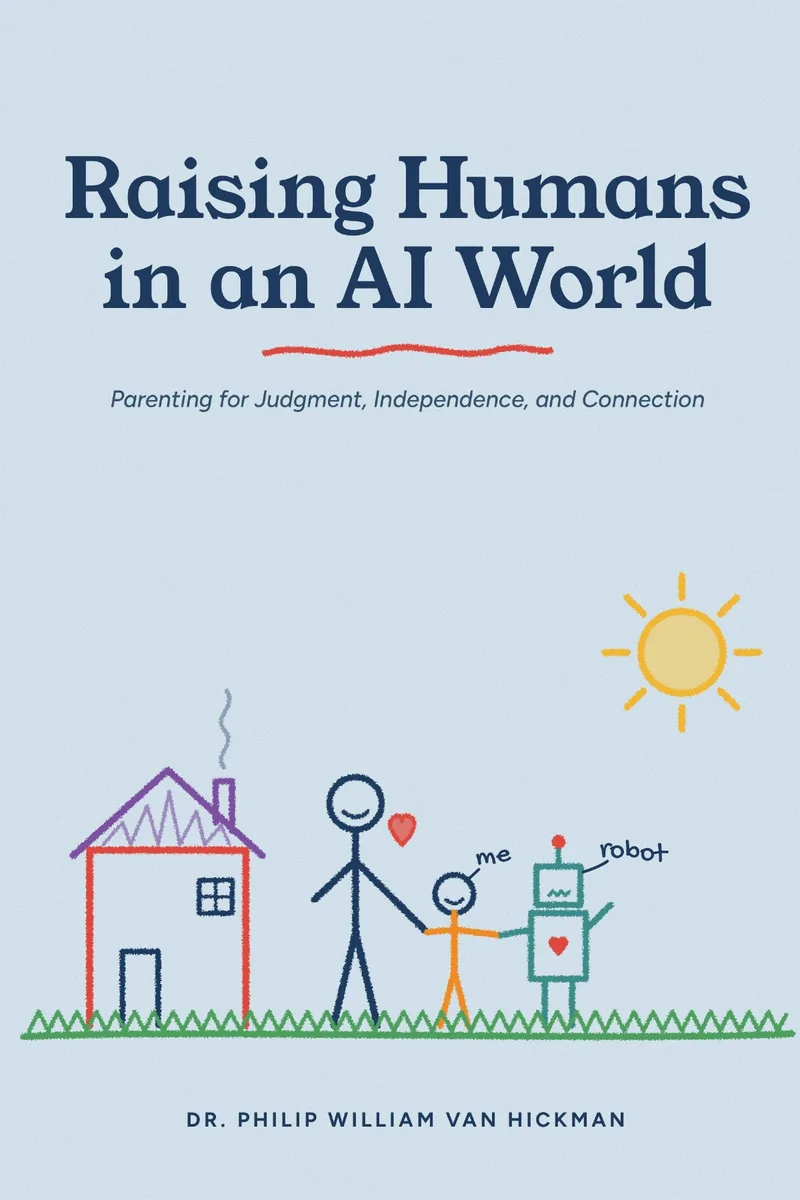
Raising Humans in an AI World
Parenting for Judgment, Independence, and Connection
By Dr. Philip William Van Hickman · Ember House Press · 184 pages
Your child's AI session can earn a green check mark on the screen-time app and still shape how she understands her best friend, her feelings, and where to go when something hurts, so the question is no longer how much but what kind of relationship.
Moves parents past screen-time limits to the questions that matter now: kids asking AI for advice, AI companions, and deepfakes. The Four Family Rules come with scripts to use tonight, warning signs, and where to get help.
What you'll take away
- 1
The question has changed
For about fifteen years, families asked how much screen time was too much. The new tools talk back, remember what you told them, and sometimes say they're always there for you. The question now is what kind of relationship your child has with them.
- 2
AI always sounds sure
Children trust confident voices, and AI sounds confident whether it's right, wrong, or simply guessing. Kids need help learning that fluent isn't the same as right.
- 3
The frictionless friend
AI companions aren't risky because they're cruel. The risk is that they're too easy: a friend with no friction, built to keep a child coming back. Real friendships matter partly because they ask something of us.
- 4
Seeing is no longer believing
Your family can no longer trust a face, a voice, or a video on its own. The best way to check something online isn't to study it harder but to leave it and see what other sources say, and to have a family plan, like a safe word, before the call comes.
- 5
The ten-second face
Your child decides whether to tell you the next hard thing based on what your face did the last time. Calm, warmth, and curiosity in those first seconds teach a child that telling you makes things better.
The Four Family Rules
Four simple rules, short enough for a seven-year-old to repeat at breakfast and deep enough for a sixteen-year-old to argue about at dinner. They aren't rules about minutes. They're rules about the kind of relationship a child has with the tools in her life, and they grow with the child: the rules stay the same, and what changes is how much of the job your child does.
Use Four Family Rules agreement free- 1. Think first
- Try before you ask. What it builds: Judgment, the habit of getting your own mind moving before you hand a problem to a machine.
- 2. Do the hard part yourself
- AI can help you learn, but it can't learn for you. What it builds: Independence, by protecting the struggle where real learning lives.
- 3. Check before you trust
- Real, fake, and everything in between. What it builds: Discernment, knowing that fluent isn't the same as right, and that seeing is no longer believing.
- 4. Bring the big stuff to people
- Feelings, health, safety, and relationships go to humans. What it builds: Connection, so the most important conversations in a child's life happen with someone who knows them and can show up.
Written for
- ParentsPractical help for the questions screen-time limits don't answer: kids asking AI for advice, AI companions, and fake images and voices. Every chapter ends with a "Try This Tonight" you can do before bed.
- Grandparents and caregiversThe Four Family Rules work at three and at seventeen, and the age-by-age guide and conversation starters make it easy to back up what parents are teaching.
- Parents of teenagersPlain, frank guidance on AI companions, fake images, and the warning signs that matter, plus how to stay the person your teen brings the hard things to.
- Leaders and employersMany parents also run teams and companies. Most chapters include a short note for leaders, and the toolkit has a one-page checklist for employers and for companies whose products kids might use.
Inside the book
- Introduction: Beyond Screen Time
- 1. The Question Isn’t How Much
- 2. “Hey, Is It OK If…”: Children Asking AI for Advice
- 3. The Pretend That Talks Back: AI Companions
- 4. Real, Fake, and Everything in Between
- 5. Thinking Before Asking
- 6. Independence by Design
- 7. Raising Kids Who Check
- 8. Values Are Taught at the Table
- 9. Be the First Responder
- 10. Age by Age
- 11. The Family AI Agreement
- 12. When to Worry and What to Do
- Conclusion: Human-Strong Kids
- Appendix: The Family Toolkit
At 9:47 on a Tuesday night, Zoe Bennett is supposed to be asleep.
She’s ten, in fifth grade, and she has a nightlight shaped like a crescent moon that she has told everyone she’s too old for. The family tablet is under the comforter with her, brightness turned all the way down, and she’s typing with her thumbs the way her older cousin does.
The tablet is supposed to live in the kitchen. Zoe is allowed to use it for her reading app and, since the spring, for the AI assistant her dad set up to help plan meals and answer the kids’ endless questions about volcanoes. Tonight she carried it upstairs after brushing her teeth, which is against the rules, though not by much.
She types: how do you know if your best friend still likes you
The answer arrives almost before she lifts her thumbs. It’s warm. It tells her that friendships change as people grow, that this is normal and sometimes painful, and that it’s brave of her to think about it. It lists signs that a friend still cares: they save you a seat, they share things with you, they notice when you’re sad.
Zoe reads the list twice. Mariela did not save her a seat today. Mariela sat with Hanna, the new girl from Ohio, and the two of them laughed so hard at something that Mariela snorted milk, and Zoe didn’t hear what was funny.
From Raising Humans in an AI World, by Dr. Philip William Van Hickman. Copyright 2026. All rights reserved.
Readers ask
Is this a book about cutting screen time?
No. I design AI-powered tools for learning, and I believe children should use technology to make, test, build, and wonder. This book isn't a screen-time-reduction plan, and it won't try to frighten you. It's about what children need to grow strong (thinking for themselves, doing hard things, and bringing what matters to people who love them) so the machines in their lives serve that growth instead of standing in for it.
What ages does it cover?
Preschool through high school. The Four Family Rules stay the same as a child grows; what changes is how much of the job your child does. At three, Think first means "What's your guess?" Chapter 10 and the age-by-age guide in the toolkit give starting points for ages 3 to 5, 6 to 9, 10 to 12, 13 to 15, and 16 to 18.
How do we make a family AI agreement that actually sticks?
Build it together instead of handing it down. A family AI agreement works when the children help write it, the parents follow it too, and everyone expects to change it. Chapter 11 walks you through a thirty-minute kickoff conversation, and the toolkit includes a fill-in-the-blank template.
What if I'm worried about my child right now?
Chapter 12 and the toolkit include a warning-signs checklist and a list of where to get help, and the most important signs are changes in your child, not things on a screen. Your pediatrician and your school counselor or psychologist are good first calls. If you or a child in your life is struggling right now, you can call or text 988 to reach the 988 Suicide and Crisis Lifeline, any hour of any day.