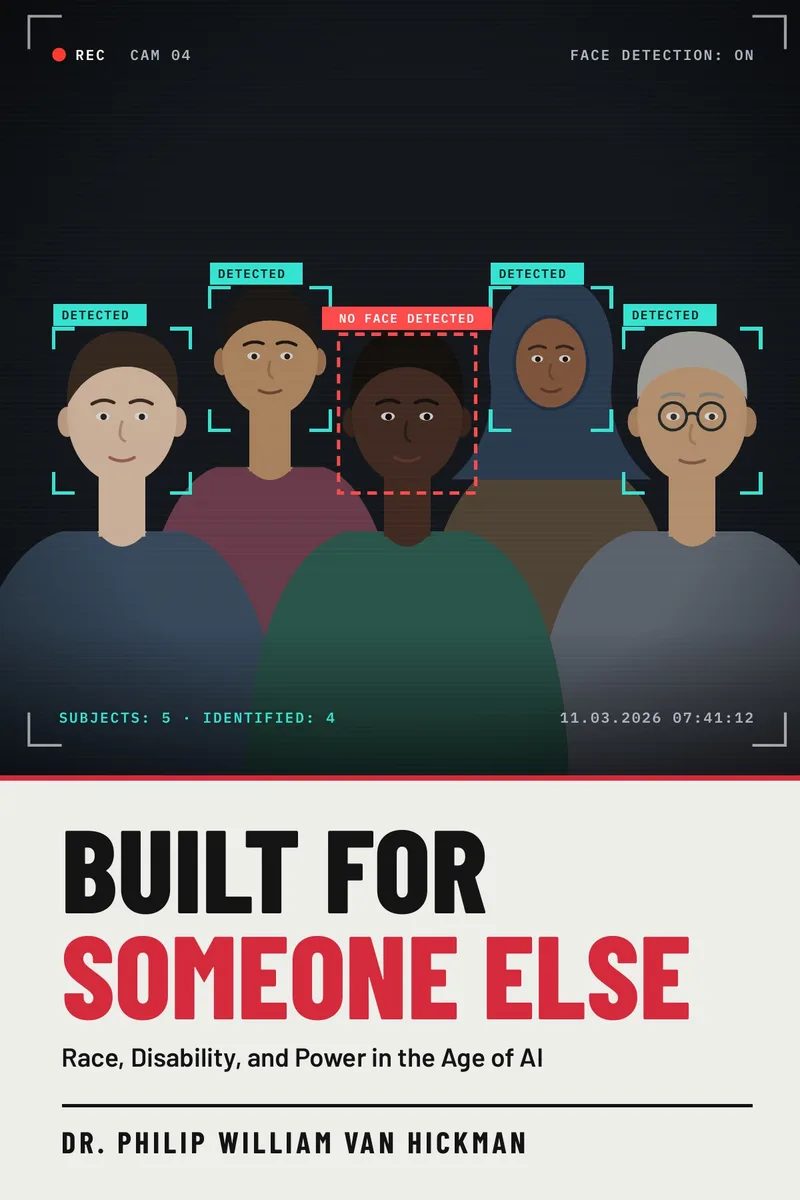
Built for Someone Else
Race, Disability, and Power in the Age of AI
By Dr. Philip William Van Hickman · Ember House Press · 194 pages
Every technology imagines someone, and when AI decides who gets flagged, hired, admitted, or believed, falling outside that imagined person stops being an inconvenience and becomes a barrier.
An investigative look at how AI imagines a "default user," and what happens to everyone outside that picture in hiring, schools, health, and policing. The BUILT Questions give leaders a fair test for any system they buy or build.
What you'll take away
- 1
The default user
A door imagines a person tall enough to reach the handle. A video interview imagines someone who hears the question. The people outside the default are rarely a random slice of humanity, and when the system makes decisions that matter, the default becomes a barrier that runs millions of times a day.
- 2
Data is history with a hard drive
Data is a careful record of what happened, including everything that was unfair about what happened. Train a machine on the past and it learns the patterns you have, not just the ones you want. If you want a different future, you have to decide that on purpose.
- 3
The outliers are people
A system tested on the middle fails on anyone the average forgot. Outliers in data about people are often people who are different, not errors. Build like it.
- 4
The unsigned no
More and more decisions are made or shaped by software, and when you go looking for the person responsible, there isn't one. An unsigned no is a denial with consequences but without an author, and it falls hardest on the people least able to fight it.
- 5
The accessibility paradox
The same technology can open doors or close them. Designed with disabled people, it opens doors; bolted on in front of them, it closes them. The people your system is most likely to fail are the best product research you're not paying for.
The BUILT Questions
Five questions you can ask about any AI system that touches someone's opportunity: a proctoring program, a résumé screener, a benefits portal, an identity check, an AI tutor. They won't tell you whether to buy a product or ban it. They tell you what you need to know before you decide, and they work just as well when you're the one building.
Use The BUILT Questions scorecard free- B: Builders
- Who designed it, and who was missing from the room?
- U: Users
- Who was the imagined user, and who falls outside that picture?
- I: Inputs
- Whose lives are in the data, and whose are absent or distorted?
- L: Limits
- Where does it fail, and on whom was it tested?
- T: Trace
- Can the person affected see, challenge, and correct the decision?
Written for
- School and district leadersIn a school system, buying an AI tool is a civil rights decision, whether you treat it as one or not. Chapter 11 is written for the people who choose what students are tested, flagged, and tutored by.
- HR and technology buyersYou don't have to be a technical expert to govern AI. You have to be the person in the room who asks better questions than the sales deck answers, and the worked examples show you how.
- Builders and product teamsThe BUILT Questions aren't only for buyers. They show a team where to look around its own table, whom to design for from the first sketch, and how to test with real people before launch.
- Policymakers and executivesChapter 12 makes the case that you can outsource the software, but you can't outsource the responsibility, and lays out what employers, builders, and policymakers can do now.
Inside the book
- Introduction: The Default User
- 1. Who Was in the Room?
- 2. Data Is History with a Hard Drive
- 3. The Outliers Are People
- 4. Seen Wrongly
- 5. In the Classroom
- 6. At the Hiring Gate
- 7. The Unsigned No
- 8. The Accessibility Paradox
- 9. Lived Experience Is Expertise
- 10. The BUILT Questions
- 11. For School and District Leaders
- 12. For Employers, Builders, and Policymakers
- Conclusion: Built With
- Appendix: The BUILT Toolkit
On Monday morning, Renee Castellano props her laptop on a stack of cookbooks so the camera sits at eye level. She’s done this enough times to know the angles.
The job is a claims analyst position at an insurance company, the kind of work she did well for six years. The interview is “one-way,” which means there’s no interviewer. A prerecorded woman in a blazer appears on the screen and asks a question. Then a timer starts, and Renee has ninety seconds to answer into the camera.
The video has no captions. Renee is Deaf. She reads the woman’s lips for the first few words, then loses her when the woman glances down at her notes. Renee clicks the help icon. It offers a page about browser settings.
Eleven days later, an automated email thanks her for her interest. A link offers “candidate insights.” She clicks it. Her results describe her as below benchmark on something called engagement, and suggest she work on her listening skills.
Renee reads the phrase twice. Then she closes the laptop and sits with her hands flat on the lid for a long time.
From Built for Someone Else, by Dr. Philip William Van Hickman. Copyright 2026. All rights reserved.
Readers ask
Is this an anti-AI book?
No. I build AI tools, and I believe in what well-designed technology can do for a child who can't yet read the page or a worker who can't hear the meeting. People are biased decision-makers too, and algorithms can be tested and fixed in ways people can't. The question in this book is never "AI or no AI." It's built by whom, for whom, and with what recourse.
Do I need a technical background to use the BUILT Questions?
No. They were designed for leaders, not engineers. Five questions is few enough to remember in a meeting without notes, and each one can be asked in plain English and answered, or not answered, in a way any executive can judge.
What if a vendor won't answer the questions?
Many won't, at first. A vendor who can't tell you how their product performs for different groups doesn't know how it performs, and you're about to inherit that gap. Your purchasing power is real, and if the vendor truly can't answer, you can run a pilot on your own population and measure the results by group.
What's in the toolkit at the back?
A one-page BUILT worksheet you can score green, yellow, or red, a vendor procurement checklist, a guide for applicants, students, and employees requesting an accommodation, and a short glossary. Nothing in it is legal advice, and your own counsel should review any policy before you adopt it.