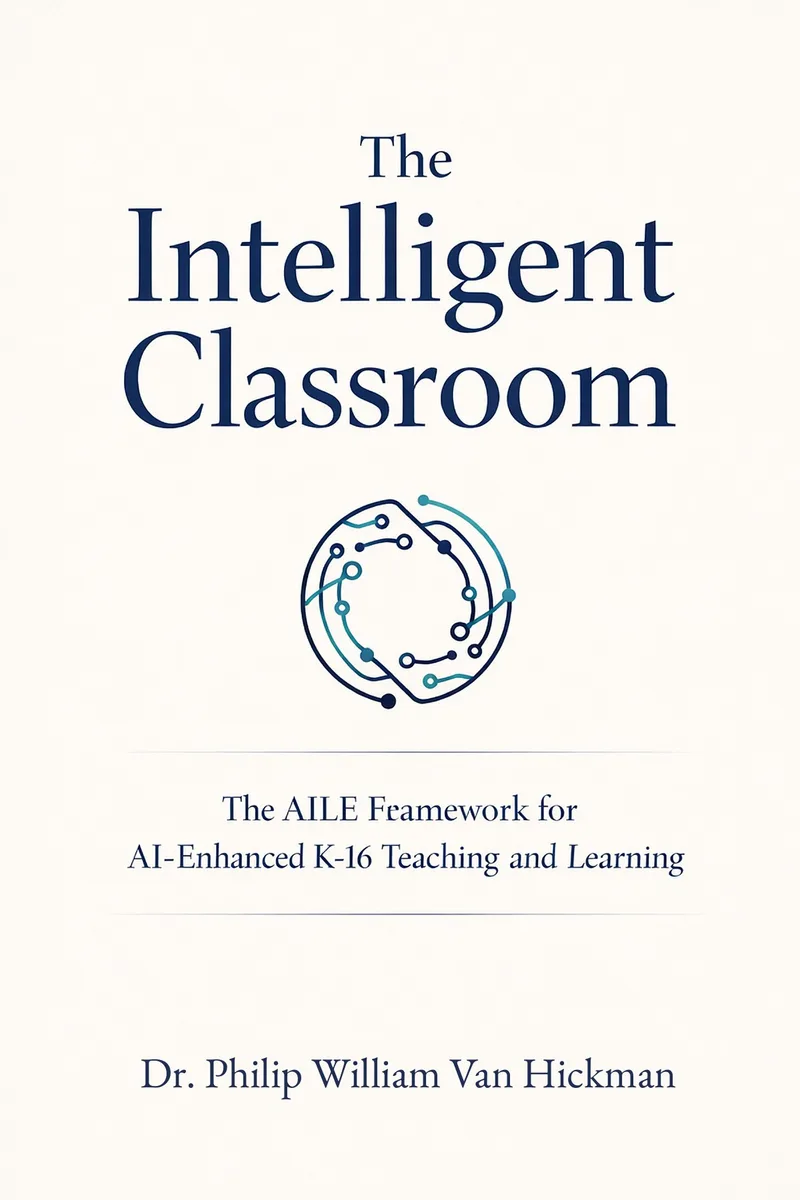
The Intelligent Classroom
The AILE Framework for AI-Enhanced K-16 Teaching and Learning
By Dr. Philip William Van Hickman · Ember House Press · 268 pages
The same AI can double learning or quietly hollow it out, and the difference is design: this is the framework that keeps the thinking with the student and the decisions with the teacher.
A practical framework for K-16 teachers and leaders. AILE upgrades the ITI instructional model with AI: entry points that read the whole student, the I Do, We Do, They Do, You Do phases, High Impact Centers, an intelligence layer, and the 5 C's and 4 R's for the AI era. Twelve chapters in five parts, with 23 figures and many tables.
What you'll take away
- 1
The structure is the problem, not the teacher
Students now walk from homes reshaped by AI into classrooms built on a factory blueprint: age-graded rooms, bell-timed periods, one adult managing thirty students at once. A good teacher inside that structure is doing exactly what the building was designed for. My critique is aimed at the architecture, not at the people working in it.
- 2
Keep the model, upgrade the delivery
The research on effective teaching was never a secret: gradual release, differentiated entry, formative assessment, feedback that arrives in time to matter. What was missing was a delivery system that could make all of it work for every student, every day. AILE does not demolish the ITI Instructional Model; it elevates it.
- 3
The tool fits the task to the student, never the other way around
The rule that governs every phase is simple to state and hard to enforce: the tool may make the task fit the student, but it may never do the student's thinking. When the teacher steps back in They Do and You Do, AI must not step in. Every task should leave evidence that the student, and not the machine, did the work.
- 4
AI recommends, the teacher decides
AI can hold six streams of readiness evidence for every student at once, and it never gets tired. It still does not make the entry point call or the placement call. A teacher's annotated override, from someone who knows the child, is the most valuable data point the system receives all week.
- 5
The human core is the point
The 4 C's and the 4 R's are not a layer; they are the ground the whole framework stands on. AILE adds a fifth C, Computational Intelligence, for a world where students think alongside machines, and adds Digital Citizenship to Respect, Responsibility, Responsiveness, and Resourcefulness.
The AILE Framework
AILE, the Artificial Intelligence-Instructional Learning Ecosystem, upgrades the ITI Instructional Model through five layers that run at the same time rather than in sequence. Think of the difference between a building and a smart building: the rooms and their purposes stay the same, and the building now knows who is in it. Underneath all five layers sit the 5 C's and the 4 R's.
Use AILE lesson planner free- Layer 1: Gradual Release
- The instructional core: I Do, We Do, They Do (Ya'll Do), and You Do. Responsibility moves from teacher to student, and AI adds live readiness signals in I Do, feedback for every student in We Do, group flags in They Do, and calibrated tasks in You Do.
- Layer 2: AI Entry Points
- A continuous diagnostic that reads six streams of evidence and recommends where each student should start. The teacher reviews every recommendation, and that step is the one that cannot be automated.
- Layer 3: Immersive High Impact Centers
- Co-Pilot, Chauffeur, Carpool, and Caboose, the four environments where the core runs. Each name says who holds the wheel, and AI acts as the dispatcher, never the driver.
- Layer 4: The Intelligence Layer
- Learning, Teacher, Assessment, and Intervention Agents, Intelligent Dashboards, and each student's Education Learning Plan. The agents give the teacher better information; the expertise and the authority stay with the teacher.
- Layer 5: Extended Learning Pathways
- Practice, reading, reflection, and challenge generated from each student's mastery profile, so the work that happens at home informs tomorrow's groupings instead of dying at the classroom door.
- The human core: the 5 C's and the 4 R's
- Communication, Collaboration, Critical Thinking, Creativity, and Computational Intelligence, with Respect, Responsibility, Responsiveness, Resourcefulness, and Digital Citizenship as the behavioral foundation of responsible AI use.
Written for
- TeachersEvery chapter opens in a classroom with a realistic problem and ends with a Monday Morning tool you can use without buying anything.
- PrincipalsYou get a shared language for what AI should and should not do in each phase of a lesson, which makes coaching, walkthroughs, and policy far easier to align.
- District leadersPart V covers leading the transition, including the AILE Transition Cycle, a readiness scan, and a first-thirty-days plan, so you govern before you buy.
- Teacher educatorsThe framework is grounded in gradual release, formative assessment, and cooperative learning research, which makes it a clear bridge between methods courses and AI-era classrooms.
Inside the book
- Preface: A Note Before You Begin
- Chapter 1: The Classroom Time Forgot
- Chapter 2: What Every Educator Needs to Know About AI
- Chapter 3: From ITI to AILE
- Chapter 4: Entry Points, Reimagined
- Chapter 5: I Do and We Do
- Chapter 6: They Do and You Do
- Chapter 7: The High Impact Centers
- Chapter 8: The Intelligence Layer
- Chapter 9: The 5 C’s, Evolved
- Chapter 10: The 4 R’s, Evolved
- Chapter 11: Leading the Transition
- Chapter 12: The Intelligent Classroom
Marcus is seventeen. It is 6:50 on a Tuesday morning in October, and he is at the kitchen counter with his phone in one hand and a bowl of cereal going soft beside the other. Before his mother has finished her coffee, he has asked an AI assistant to summarize three articles on the state’s new climate bill, and he has read closely enough to catch one summary that gets the bill’s timeline wrong. He tells the tool so. It corrects itself. A friend posted a claim overnight that the bill will double electric rates, so Marcus asks the assistant to find the source. There isn’t one, and he says so in the group chat. Then he opens the college application prompt that has been sitting in a browser tab for a week and asks for help outlining a response about the creek behind his grandmother’s house. He rejects the first outline as generic. He keeps the second and moves two sections around. He prompts, evaluates, pushes back, revises. By 7:45 a.m., he has done more higher-order thinking than most standardized tests will ever ask of him.
At 8:00, Marcus walks into first period.
From The Intelligent Classroom, by Dr. Philip William Van Hickman. Copyright 2026. All rights reserved.
Readers ask
Do I need special software to use AILE?
No. Every chapter ends with a Monday Morning tool your team can run with what you already have, from the Entry Point Decision Sheet to the Center Rotation Planner. Where a district has dashboards, they make the cycle faster. Where it does not, your gradebook, an exit ticket, and your own notes run the same cycle by hand.
Is AILE a replacement for the ITI Instructional Model?
It is an upgrade. The four phases, the Entry Points, and the High Impact Centers stay; AI adds responsiveness, precision, and reach to each one. If you already run gradual release, you are standing on the right foundation.
Where should AI stay out of a lesson?
Wherever it would do the student's thinking. In the book, one team decided that during I Do the model is the point, so no AI, and that during You Do students could only ask AI questions about their own writing and had to submit those questions as evidence. The point is to design where AI belongs, because a ban without a design is just a ban you cannot see.
Does the book address students with disabilities and multilingual learners?
Yes, throughout, not as a strand bolted on at the end. The framework rests on the premise that every student deserves the full model, not a modified version of it. The students the system has most often failed are the ones with the most to gain when it finally works.