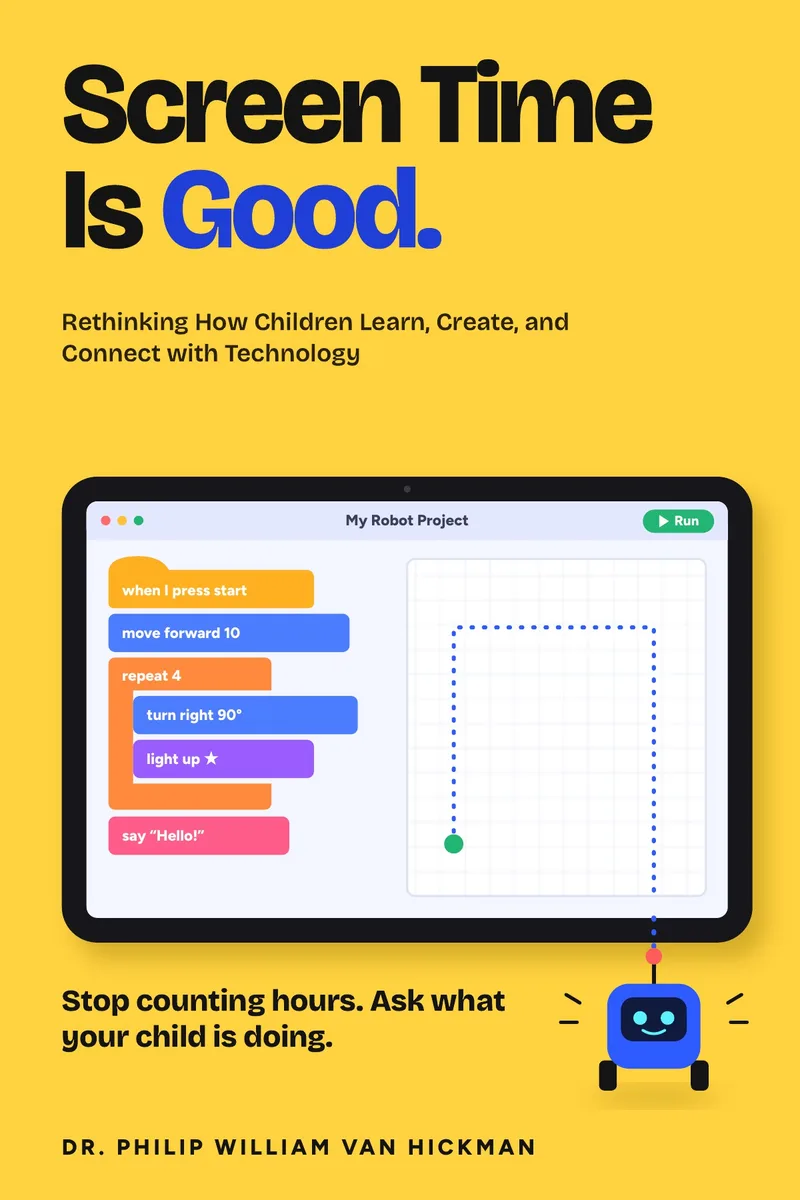
Screen Time Is Good
Rethinking How Children Learn, Create, and Connect with Technology
By Dr. Philip William Van Hickman · Ember House Press · 240 pages
Stop counting hours and start asking what your child is doing: the case for computers, coding, robotics, and well-designed AI, told by someone who is blunt about the real harms.
Stop counting hours. Ask what your child is doing. The case for computers, coding, robotics, and well-designed AI at school and at home, blunt about the real harms: lost sleep, the algorithmic feed, the phone in the classroom. Includes the Screen Quadrant, the MAKER test, honest evidence labels, family plans by age, a buying guide for schools, and 23 illustrations and charts.
What you'll take away
- 1
The hours question cannot see what matters
Two nine-year-olds can spend the same four hours on a screen, one making a stop-motion film and one watching whatever autoplay serves next. A clock cannot tell them apart. In a 2019 analysis of large adolescent surveys, Amy Orben and Andrew Przybylski at Oxford found the link between technology use and well-being was about the same size as the link with eating potatoes.
- 2
Up and to the right
Two questions sort every screen session: is the child consuming or creating, and alone or with someone? The parent's job, and the principal's, is not to count hours. It is to move a child from consuming toward creating and from alone toward together.
- 3
Dose, design, and dialogue
The old debate was entirely about dose, how much, and the clock measures it; this book is about the other two. Design is what the thing is built to do to a child, and the MAKER test measures it. Dialogue is who is talking with the child about it.
- 4
The phone is not the computer
I support classroom phone bans, because a smartphone is a consumption device by design while a laptop and a robotics kit are tools. A ban alone is half a policy, so fill the freed attention with tools that make children think. Ban the phone, buy the robot.
- 5
Honest about the harms
The book concedes six real harms, including lost sleep, the algorithmic feed, and unsafe contact or content, and shows where design and family rules can address them. Every research claim carries a label, robust, mixed, or weak, applied as honestly to the evidence that complicates my argument as to the evidence that supports it.
The Screen Quadrant and the MAKER Test
The Screen Quadrant is a way of seeing, not a scientific instrument: one line runs from consume to create, the other from alone to together, and the two make four corners. The MAKER test then judges the thing itself, any app, device, or purchase, with five questions where yes is the good answer.
Use The Screen Quadrant free- The feed
- Alone and consuming: algorithmic social media, autoplay video, solo scrolling. An algorithm chooses what happens next, and nearly every harm with robust evidence behind it lives here.
- Co-viewing
- Together and consuming: a family film, a video call with a grandparent. It has a better record than its reputation, because the person beside the child is live and responds.
- The studio
- Alone and creating: building in Minecraft, coding in Scratch, editing a film. The child decides what happens next, and something exists at the end that did not exist at the beginning.
- The team
- Together and creating: a robotics team, a coding club, a shared build. It is the best thing a screen does, because the showing is where the making becomes learning that holds.
- The MAKER test
- Makes something new, Adapts to the child, Keeps them thinking, Ends with something to show, Reaches others. Five yes is a tool. Five no is a pacifier.
Written for
- ParentsYou get a way to look at screen time that is about what and with whom, not how long, plus family plans by age and bright lines worth holding: no algorithmic feeds before mid-adolescence, no phones in bedrooms, no autoplay for anyone.
- TeachersThe book makes the case for coding, robotics, games that teach, and AI tutoring with guardrails, and shows how to tell a tool that makes students think from a drill program with a curriculum attached.
- School leadersMeasure one-to-one devices by what students make, not by devices or minutes. The procurement rubric turns the MAKER test into questions for every vendor demo.
Inside the book
- Chapter 1: The Potato Problem
- Chapter 2: A Screen Is Not a Screen
- Chapter 3: What the Evidence Actually Says
- Chapter 4: The Phone Is Not the Computer
- Chapter 5: The Brain Wants a Challenge
- Chapter 6: Papert Was Right
- Chapter 7: The Tutor Who Never Tires
- Chapter 8: The Child Who Builds the Robot
- Chapter 9: Coding Is the New Cursive
- Chapter 10: Games That Teach (and the Ones That Don’t)
- Chapter 11: Creating Over Consuming
- Chapter 12: The AI Studio
- Chapter 13: Technology as Access
- Chapter 14: The Honest Harms and How Design Fixes Them
- Chapter 15: The Family Media Architecture
- Chapter 16: The School That Gets It Right
- Chapter 17: 2036: The Child Who Grew Up Making
Maya is nine, and on the Saturday I want to tell you about she spent four hours and ten minutes in front of a screen. Her mother, Keisha, knows the number because she checked. Keisha had read the articles. She had seen the chart of teenage anxiety climbing after 2010. She had a rule, two hours on weekends, and the rule was in ruins by lunch, and she stood in the doorway of the dining room with the particular guilt of a parent who has lost a fight with a tablet.
Here is what Maya was doing in those four hours and ten minutes. She was making a stop-motion film about a fox who steals a sandwich. She had built the fox out of modeling clay the night before. She had drawn the kitchen on a shoebox. She shot two hundred and eleven photographs, moving the fox a quarter inch at a time, and when the fox’s ear fell off at frame one hundred and forty she went back and reshot thirty frames rather than let the ear vanish. She recorded the fox’s voice and did it six times because the first five “sounded like a person, not a fox.” She added a title card. The finished film is forty-one seconds long. She has watched it, by her own count, “a hundred times,” and she has shown it to her grandmother on a video call, and her grandmother asked for a sequel.
From Screen Time Is Good, by Dr. Philip William Van Hickman. Copyright 2026. All rights reserved.
Readers ask
Are you saying screen time limits do not matter?
No. Dose still matters, and the book is blunt about sleep, the algorithmic feed, and the phone in the classroom. My argument is that the total number of hours is a poor predictor of how a child is doing. What the child is doing, and with whom, tells you far more.
What is the MAKER test?
Five questions for any app, device, or program: does it make something new, adapt to the child, keep them thinking, end with something to show, and reach others? Five yes is a tool and five no is a pacifier. Most things land in between, and the missing letters tell you what to fix.
Do you support phone bans in schools?
Yes, for classrooms. The phone and the computer do different jobs, and the classroom phone pulls a child toward the feed. But a ban by itself supplies nothing, so the book pairs it with computers, robots, and AI tutors that make children think. Phone-free, screen-rich.
How do I know which research claims are solid?
Every research claim in the book carries a label: robust, mixed, or weak. I applied those labels as honestly to the evidence that supports my argument as to the evidence that complicates it. Where I could not confirm a number, I left it out.