Leading people through AI without breaking their sense of worth
How you roll out AI teaches people what you think they are worth. A leader's guide to telling the truth, protecting identity, and making room for grief.
Read the essay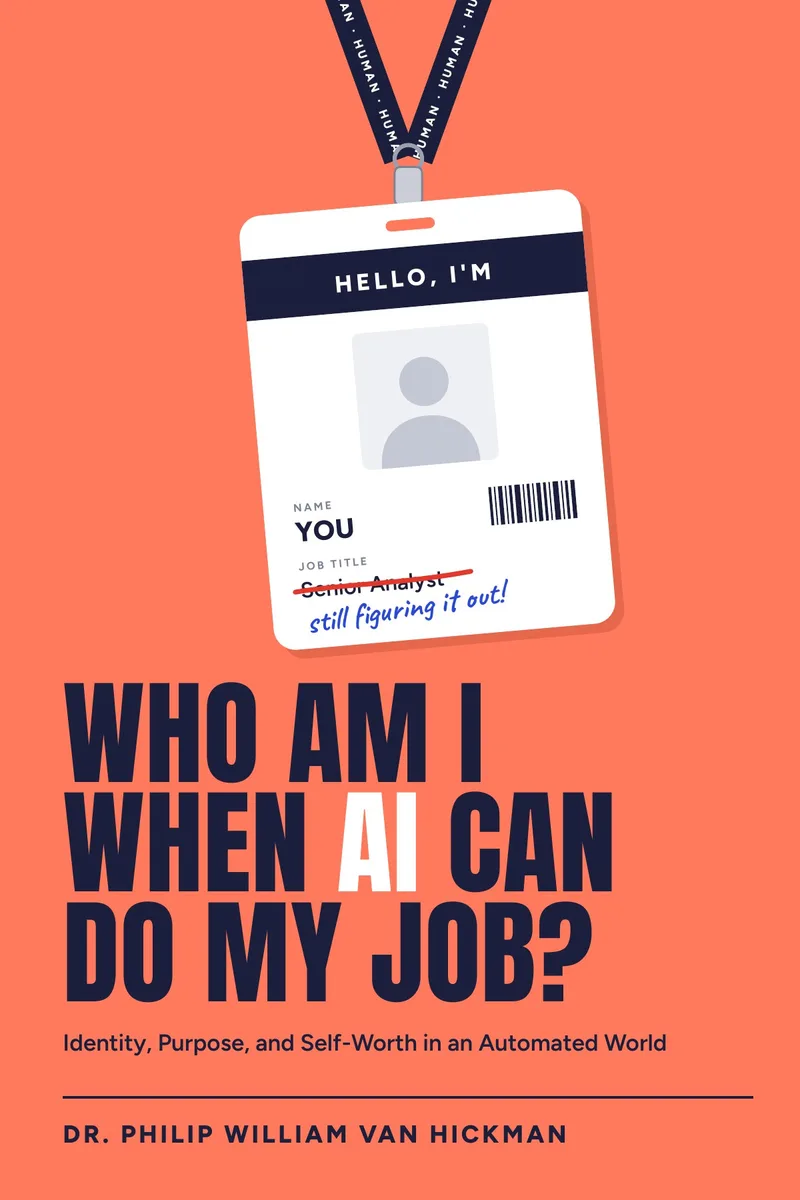
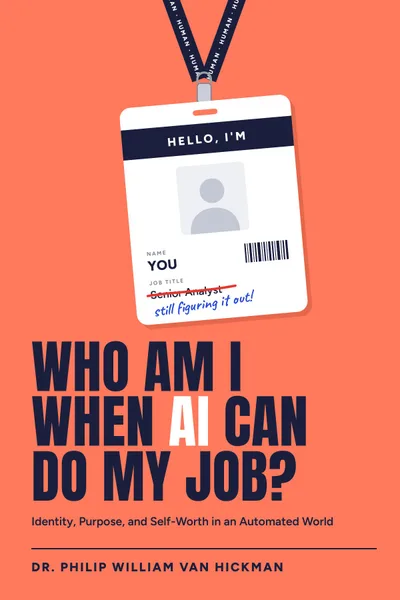
Identity, Purpose, and Self-Worth in an Automated World
By Dr. Philip William Van Hickman · Ember House Press · 178 pages
When a machine does in eleven seconds what took you a day, the real question is not about your paycheck but about who you are, and this book gives you a better answer than "nothing" or "don't worry about it."
A straight-talking, funny guide for workers who fear being replaced and for the CEOs leading them. The Tasks, Roles, Self framework and a four-step reinvention path separate personal worth from productivity.
When people talk about AI and their work, the first worry is often not money at all. It sounds more like "What am I for?" The people who come through this well will be the ones who learn to answer "Who are you?" without a job title.
After years of being the one who does a thing well, your Self gets welded to your tasks. Then a machine does the task, and it feels like it wrote you out of the story. Fusion isn't permanent, and pulling the layers apart makes the problem the right size.
Hoarding what you know can feel like safety for years. In an AI workplace, it is the fastest way to become the problem. Teaching, documenting, and sharing are what make you worth keeping.
Nobody thinks their way into who they will be next. You get there through small, cheap, real experiments, one at a time, and the foggy middle is where reinvention actually happens, not a sign you're failing at it.
How you roll out AI will teach your people what you think they're worth, and they'll remember that lesson long after they've forgotten the software. The three-part truth (what we know, what we don't know yet, and when we'll know more) gives leaders an honest way to start.
Your working identity has three layers. AI can automate your tasks and reshape your roles, but it can't touch your Self. You lose that only if you've welded it to the other two, and a four-step path (name the loss, inventory what's yours, run small experiments, write the next chapter) helps you build what comes next.
Use Tasks, Roles, Self sorter freeDenise Whitaker has written maybe four thousand legal research memos in her life. She’s never timed one.
Today, someone else is timing it for her.
It’s a Tuesday afternoon at Hollis & Marsh, a forty-lawyer firm in a mid-size American city, and the managing partner has gathered the paralegals in the big conference room for a demonstration of the firm’s new AI research tool. There’s a plate of cookies nobody’s touching. Denise, fifty-four, has been a paralegal here for twenty-six years. She trained half the people in this room. She knows which judges hate long footnotes, which clients call at 6 a.m., and where every closed file from 2003 lives.
The vendor, a friendly woman in a blazer, types in a question about a contract dispute. It’s a real question, the kind Denise would normally spend most of a day on: pulling cases, reading them, checking which ones still hold up, and writing a clean memo an attorney can trust.
The vendor hits Enter.
Someone in the back says, “Wait, is it done?”
It is. Eleven seconds. A full memo, organized, with citations, a summary, and a short section on counterarguments.
Denise reads it. It’s good. Not perfect. She spots two cases it describes a little too generously, the way a first-year associate does when they want something to be true. But it’s good. It’s better than some memos she’s seen from people with law degrees.
From Who Am I When AI Can Do My Job?, by Dr. Philip William Van Hickman. Copyright 2026. All rights reserved.
No. I won't give you a list of "AI-proof jobs" that will be out of date before you finish reading it. This book is about the part that keeps you up at night even when the bills are paid: the place where your sense of who you are got tangled up with what you do.
Yes, with one honest caveat. Your fear about money is real and rational, and I won't tell you to just "reframe it." What the book offers is help with the other half of the problem: who you are now, what is still yours, and how to start acting your way toward what comes next.
I'm a clear-eyed optimist. I build AI tools for education, and I believe they can make people more capable, not less. I also believe the way we talk about AI and work is doing real damage to people, and some of that damage is avoidable. Where the research is early, small, or disputed, I say so.
Yes. The appendix, The Reinvention Workbook, puts every exercise in one place, short enough to use on a Saturday morning with a cup of coffee and a pen. It includes the Tasks, Roles, Self worksheet, an experiment planner, and a manager's conversation guide for AI changes.