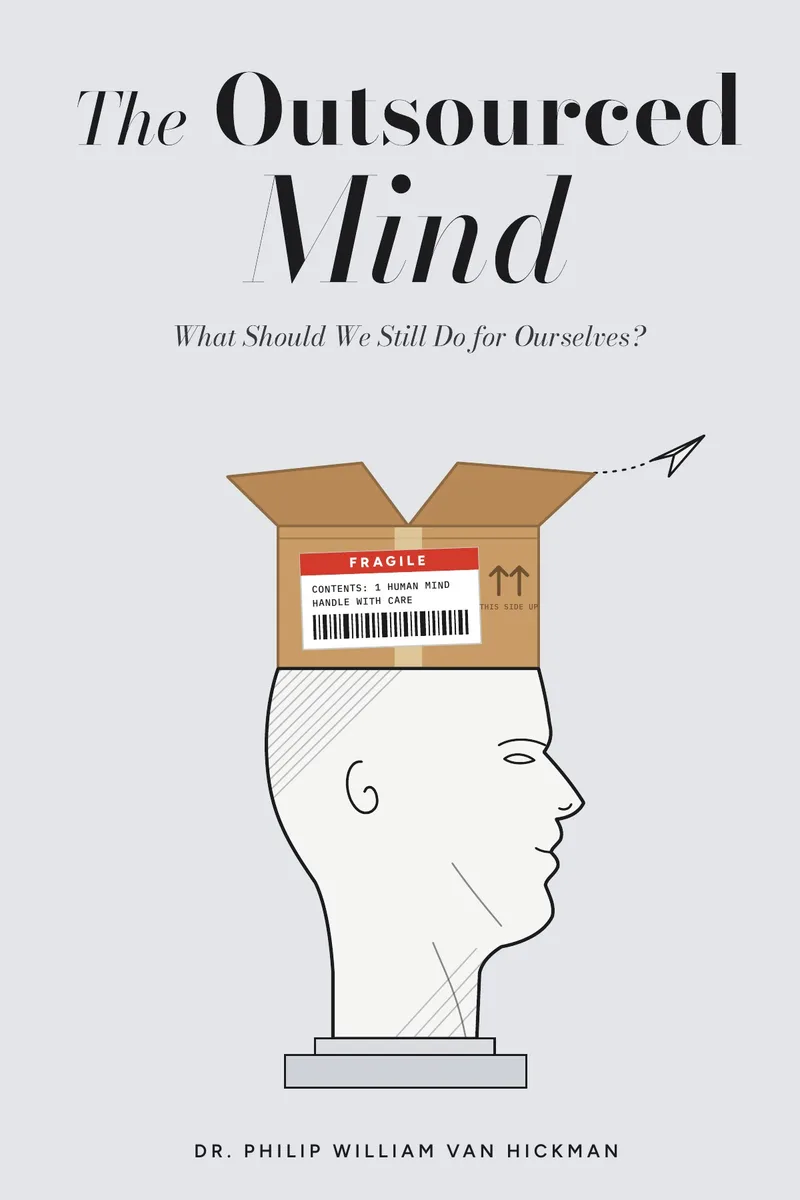
The Outsourced Mind
What Should We Still Do for Ourselves?
By Dr. Philip William Van Hickman · Ember House Press · 176 pages
A man asks AI to write the apology to his wife, it writes a beautiful one, and it makes everything worse, because the struggle to write the apology was the apology.
A witty look at what we hand to AI (our words, choices, ideas, and problem-solving) and which parts to keep. The Four Keeps and the Tutor, Coach, Collaborator, Ghost roles guide everyday readers and executives.
What you'll take away
- 1
We've always outsourced, but this is different
Writing, calculators, and maps have always carried part of our thinking, and mostly that has been wonderful. What's new is that we can now outsource the very tasks we use to find out who we are.
- 2
Some words have to come from you
Some words get their value from what they say, and some get their value from who went through the trouble of saying them. A perfect apology written by something that isn't you can land worse than a clumsy one you wrote yourself.
- 3
Rented taste
We don't just choose what we want; we find out what we want by choosing. Hand off enough choices and you can end up with preferences that live in the algorithm instead of in you.
- 4
The median muse
AI can make each of us more creative while making all of us more alike. The AI brainstorming partner is brilliant, tireless, and generous, with a gentle pull toward the middle of everything that's already been said.
- 5
The missing rung
AI helps the expert most in the long run and the novice most in the short run, and that gap can quietly trap the novice. When AI does the groundwork, it can saw off the bottom rung of the ladder junior employees were supposed to climb.
The Four Keeps
The framework in one line: offload the grind; keep what grows you. Most of what fills a day is grind, and AI is welcome to it, but mixed in are four kinds of work worth protecting. Before any handoff, four quick questions (one per Keep) tell you which part to keep.
Use The Four Keeps check free- Keep the struggle that builds you
- The effort that creates skill, memory, and expertise. Ask yourself: am I trying to get better at this? If yes, keep the hard part and ask for hints, not answers.
- Keep the words that carry you
- The messages whose meaning depends on their coming from you: apologies, condolences, thank-yous, toasts, hard conversations. If it matters that this comes from you, write the first draft yourself.
- Keep the judgment that's yours to own
- The decisions you'll answer for, to your family, your team, your customers, or your own conscience. If you'll have to answer for it, decide it yourself, with the machine as advisor.
- Keep the wonder
- The curiosity and ideas that should start in your own head: the half-formed hunch, the question you can't let go of. If it should start with you, think first, then prompt.
Written for
- Everyday readersAnyone who has ever let AI write a message they should have written themselves. The Four Questions take about ten seconds once you're used to them.
- Students and lifelong learnersThe struggle is the point. You'll learn how to make AI a Tutor that hints instead of a Ghost that answers, so the skill ends up living in you.
- Executives and leadersFor the leader deciding which AI to buy, how to train people, and what to tell the board, with guidance on growing future experts and on what a CEO should never hand off.
Inside the book
- Introduction: The Apology I Didn’t Write
- 1. We’ve Always Outsourced
- 2. Use It or Lose It?
- 3. The Struggle Is the Point
- 4. Our Words
- 5. Our Choices
- 6. Our Ideas
- 7. Our Problems
- 8. The Four Keeps
- 9. Tutor, Coach, Collaborator, Ghost
- 10. Your Personal AI Policy
- 11. Outsourcing at Work and School
- 12. What We Should Never Outsource
- Conclusion: Do It Yourself, Sometimes
- Appendix: The Four Keeps Toolkit
Kevin Brandt knew he was in trouble the moment he saw the cake.
It was a Saturday night in early October, and he’d come home from a long day at the warehouse he managed to find his wife, Lauren, sitting at the kitchen table across from an untouched chocolate cake with a single candle in it. Her phone was face down. Her coat was still on.
“Mom’s birthday dinner,” she said. “Seven o’clock. You said you’d meet us there.”
Kevin’s stomach dropped. He’d known about the dinner for three weeks. It was on the shared calendar. Lauren had reminded him that morning. And somewhere between a late truck, a short-staffed shift, and a dozen messages from his regional manager, it had simply fallen out of his head. Her mother had turned seventy. He’d missed it without so much as a text.
The argument that followed was not their best. He said he’d been slammed at work. She said he was always slammed at work. He said that wasn’t fair. She said what wasn’t fair was her mother asking, three times, whether Kevin was “all right.” Then Lauren went to bed, and Kevin sat alone in the kitchen with the cake.
From The Outsourced Mind, by Dr. Philip William Van Hickman. Copyright 2026. All rights reserved.
Readers ask
Is this book telling me to stop using AI?
No. You will use AI, and most of the time, you should. It's one of the most useful tools human beings have ever built. This book asks a different question: which part should I keep?
What are Tutor, Coach, Collaborator, and Ghost?
They're four roles the same AI can play. The Tutor helps you learn to do it. The Coach helps you do it better yourself. The Collaborator works alongside you while you stay the author. The Ghost does it in your name. All four are useful, but most of the risk lives with the Ghost, and most of us slip into Ghost mode without noticing.
Are the Four Keeps the same for everyone?
No, and they're not a purity test. What grows you depends on who you are and what you're trying to become, and the Keeps change as a skill becomes routine. They also aren't a club to swing at people who need help: for someone with a learning disability, a brain injury, or limited English, AI support may be what lets them reach the parts that grow them at all.
Is there anything practical to take away?
Yes. The appendix, The Four Keeps Toolkit, includes the Four Questions to use before any handoff, a decision guide, the four roles at a glance, a seven-day offloading audit, and a personal AI policy template that fits on one index card.